
On 16 October, UNIDIR launched its new online compendium of effective measures and practices to prevent, mitigate and counter the evolving threat posed by improvised explosive devices (IEDs). The compendium brings together insights applicable at global, regional and national levels from more than 50 States all over the world.
The UN General Assembly and Member States in different multilateral forums have long recognized that improvised explosive devices pose a significant, complex and multifaceted threat to security, stability and development in many parts of the world. Since the General Assembly first adopted a dedicated resolution addressing IEDs in 2014, more than 60 countries have been affected by the illicit proliferation of IED components and the manufacture and use of IEDs by non-state armed actors.
Over the past decade, UNIDIR has contributed to international efforts to address this challenge, including through its 2015 research on how the UN system could better use relevant processes and actors and the development of its Counter-IED Capability Maturity Model and Self-Assessment Tool. Since 2020, more than 25 States from different regions have voluntarily used the model and tool.
Despite the global attention and information generated through these efforts, States’ national authorities and experts have long lacked a way to pool knowledge on measures and practices that have proven effective in countering the threat posed by IEDs. As a result, much useful knowledge remained dispersed, with access possible only for a select few.
UNIDIR’s Counter-IED Compendium, launched at an event convened by Australia, France, Nigeria, the United Nations Office for Disarmament Affairs and UNIDIR, addresses precisely this gap.
As Ambassador Anne Lazar-Sury, Permanent Representative of France to the Conference on Disarmament, explained during the launch event:
Our intent is to maintain the international community’s attention on the subject of IED. This year, this will be the only resolution submitted by France. This shows the importance that we attach to this subject. We are also always eager to share with partners our military experience, ranging from demining, to IED analysis and prevention.

Building a shared knowledge base
UNIDIR developed the compendium using information generated through States’ use of the Capability Maturity Model and the Self-Assessment Tool, as well as responses to a structured questionnaire circulated to all UN Member States in early 2026. The Institute also drew on information gathered through its research, advisory activities and capacity-building initiatives, including official government documents and national presentations. Entries were reviewed by national and international experts, with the source of particular measures and practices being obscured to prevent them from being linked to particular States. This approach supports voluntary information-sharing while respecting the confidentiality of national contributions.
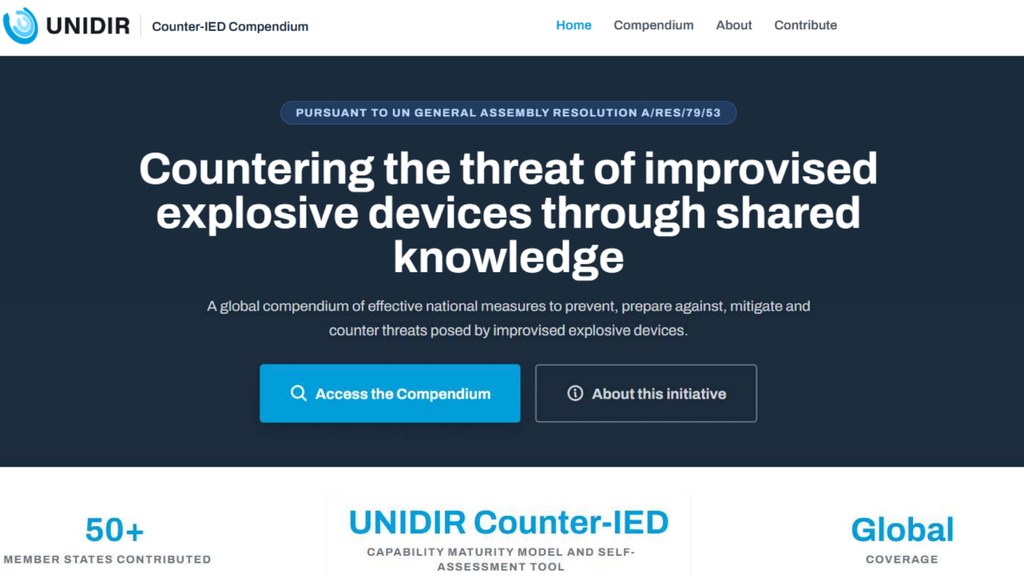
UNIDIR’s online Counter-IED Compendium is a unique global resource, informed directly by policy experiences and by the operational experience of those directly engaged in counter-IED efforts at national and local levels. With more than 50 States having contributed their insights by mid-2026, it offers unparalleled global coverage.
The measures and practices collected are split into three broad categories:
- Upstream measures, focusing on prevention and preparedness
- Downstream measures, addressing mitigation and response
- Cross-cutting or enabling measures
All of these measures are in turn structured around five capability-maturity levels, reflecting different stages of national capacity development, as well as factors that have enabled others to progress from one maturity level to the next.
Supporting national efforts and international cooperation
The compendium is intended to serve as a practical resource for Member States and other relevant stakeholders, allowing them to:
- Inform reviews and development of national strategies or action plans
- Identify measures or practices that have proven effective in similar contexts
- Inform assessments using UNIDIR’s Capability Maturity Model and Self-Assessment Tool
- Facilitate international or regional cooperation, information sharing and dialogue
- Inform international assistance and capacity-building, including programming
At the launch event, Jennifer Cavenagh, Deputy Permanent Representative of Australia to the Conference on Disarmament, underlined the need for collective action in this area:
[We] remain firmly committed to international efforts to prevent and counter IED threats: the threat posed by IEDs is a global challenge that demands a global response. [The] biennial IEDs resolution, which Australia co-leads with France and Nigeria, provides an important opportunity to highlight the seriousness of the issue, the diversity of national experiences, and the importance of practical international cooperation in countering the threat.
Other speakers also highlighted the particular importance of sustained international cooperation in responding to a threat that transcends national borders and continues to evolve. Discussion frequently turned to emerging trends, including the increasing integration of IEDs with commercially available uncrewed aerial systems, as highlighted in the 2026 report of the Secretary-General on countering the threat posed by IEDs. The compendium allows knowledge about measures and practices that have proven effective in this regard to be exchanged among States and other interested stakeholders.
Contributing to a living knowledge resource
The compendium is a dynamic and evolving resource, relying on continued voluntary contributions from Member States and relevant stakeholders, as well as regular reviews and updates to reflect lessons learned, emerging threats and novel approaches.
Member States are therefore encouraged to continue to share relevant national experiences, good practices and lessons learned for the benefit of other States and stakeholders. Contributions may include information generated through the use of the Capability Maturity Model and Self-Assessment Tool, responses to thematic questions, and existing national documents, official presentations or reports. All submissions are treated confidentially and anonymized before being included in the compendium.
By making practical national experiences more accessible across regions and contexts, UNIDIR’s Counter-IED Compendium strengthens knowledge-sharing and exchange, supports evidence-based policymaking and contributes to more coherent, comprehensive and cooperative approaches to preventing and countering the evolving threat posed by IEDs.
For information on contributing to the compendium: cap-unidir@un.org